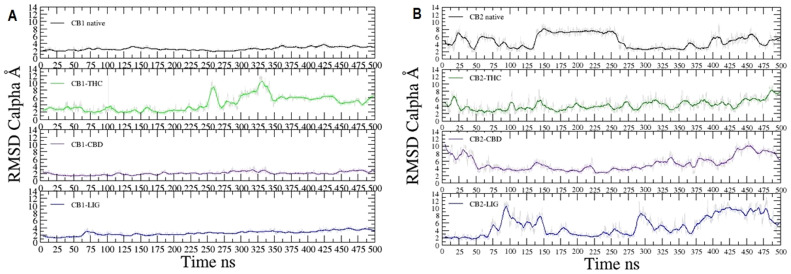
About: Running average (using 40 frames) of CαRMSD analysis for CB1 and CB2 receptors. Panel A. Top down CB1-native, CB1-THC, CB1-CBD and CB1-LIG (LS-61178). Panel B. Top down CB2-native, CB2-THC, CB2-CBD and CB2-LIG (LS-61176).

5U09, resolution of 2.6 Å for CB1 receptor and 5ZTY, resolution 2.8 Å for CB2 receptor

Virtual screening using docking and molecular dynamics of cannabinoid analogs against CB1 and CB2 receptors 6

Information

Details.

Scientist
AntistioAviz-AmadoraNeyderContreras-PuentesabJairoMercado-Camargo
Protein
CB1 and CB2 receptors,
Ligand
Δ9-tetrahydrocannabinol , cannabidiol, LS-61176
Simulation Duration
InChIKey
N/A
SMILES
N/A
Molecular Formula
N/A
Protein Details
Cannabinoid receptor 1 (CB1) and cannabinoid receptor 2 (CB2) are seven transmembrane domain G protein-coupled receptors (GPCRs). CB1 regulates neurotransmission and a range of peripheral functions, whereas CB2 regulates immune and inflammatory pathways
Ligand Details
Delta-9-tetrahydrocannabinol (Δ9-THC), better known as THC, is the marijuana plant's primary component for causing psychoactive effects. Cannabidiol (CBD) is a chemical in the Cannabis sativa plant, also known as cannabis or hemp. One specific form of CBD is approved as a drug in the U.S. for seizure. THC and a CBD analogue (LS-61176)
Attachments